The Automation Imperative#
To automate or not to automate, that is the question.
Ever since Software-Defined Networking (SDN) and DevOps appeared, engineers have argued about whether network automation is necessary, a luxury, or just overengineering. The answer? It depends. Hyperscalers need it: they started in the early 2010s because they had no choice. Small businesses might not need full automation at all. Most networks sit somewhere in the middle. Culture, skills, tool maturity, and business priorities all shape how fast you adopt. Today, all those factors are lining up. Automation is becoming inevitable.
However, an automation effort requires an accurate design that not only solves the immediate needs but also sets the foundations to evolve: an architectural approach. This is the mindset that avoids situations like this:
A network team at a regional logistics company spent three years building what they called their automation platform. Ansible playbooks for VLAN provisioning, BGP neighbor configuration, device hardening. Their code lived in Git. Changes went through peer review. Deployment took minutes instead of days. By every measure they had, they were doing automation right.
Then the company acquired a competitor and doubled in size overnight. New sites, two new vendors, naming conventions that conflicted with their own. The first time they ran their provisioning playbook against the new environment, it failed on an edge case. They patched it. It failed on another. Six weeks after the acquisition, one engineer was spending more time maintaining the automation than running the network manually would have taken.
The post-mortem was uncomfortable. The tools hadn’t failed. Ansible was fine. What had failed was invisible: there was no single description of what the network was supposed to look like. Each playbook carried its own assumptions about naming conventions, IP allocation strategies, and vendor behavior. When the environment changed, every assumption broke simultaneously. The team had automated their existing network, not built a platform that could adapt to change.
This is the pattern at the heart of every automation stall. Organizations reach a point where the automation built for today’s problem becomes tomorrow’s obstacle.
The Perfect Storm#
Automation isn’t optional anymore. Hyperscalers deal with explosive Artificial Intelligence (AI) growth: hundreds of thousands of Central Processing Unit (CPU)s and Graphics Processing Unit (GPU)s talking through massive high-speed Ethernet fabrics (with very high operational excellence expectations). Enterprises and service providers juggle legacy infrastructure, new services, cloud/on-prem/edge sprawl, and rising costs and smaller hiring budgets.
Everyone in tech has already moved to API-first, self-service. Developers expect the same from networking: not requesting services via email or long-standing tickets, but getting the same self-service experience. Security and compliance need automated, auditable processes.
The question isn’t “Should we automate?” anymore. It’s “Why haven’t we already?”
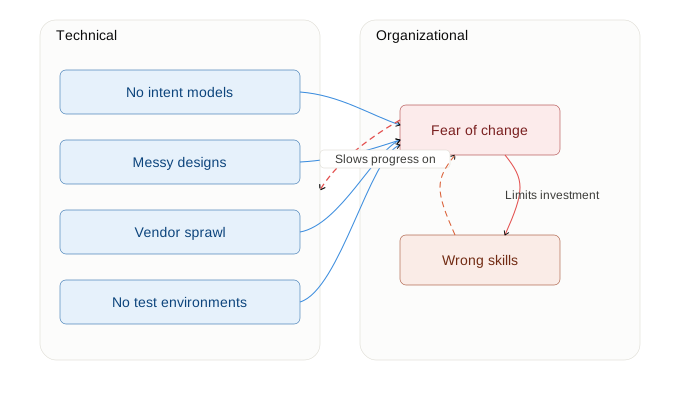
Despite clear benefits and motivations, several barriers slowed adoption, and many still apply:
- No intent models: Networks were described by device configs, not “how should the network actually behave?” Without structured and agnostic intent data, automation stays fragile, device-focused, and vendor-specific.
- Messy, inconsistent designs: Automation needs predictability. Networks full of exceptions, ad-hoc workarounds, and one-offs are extremely hard to automate. Clean, standardized designs win.
- Vendor sprawl: Mix of vendors, platforms, and services means constant integration headaches and limited capacity to evolve.
- Wrong skills: Few engineers knew both networking AND software development. That gap made automation hard to design well.
- Fear of change: Networks are critical. Conservative change management made it hard to justify automation.
- No safe test environments: Most teams lack proper labs that match production. Testing automation safely is a complicated endeavor.
These barriers don’t operate independently. They reinforce each other: without intent models, automation stays fragile; fragile automation amplifies fear of change; fear of change blocks the investment needed to build the skills and test environments that would reduce fragility.
Good news: by 2026, most of these are dissolving. Companies and vendors are moving forward. The State of Network Automation Survey by Chris Grundemann (Network Automation Forum) shows the shift happening now. Still, there’s no single magic formula. Understanding the mindset comes first.
Thus, we still have to prepare and foster a structured approach to embrace network automation effectively, no matter how necessary it seems.
How to approach network automation#
This book covers the fundamental architecture concepts you need to implement successful network automation solutions. Don’t chase a single tool: no silver bullet exists. Success comes from combining three pillars: People, Process, and Technology (in that order).
The three pillars of success#
Like Maslow’s pyramid (you need a solid foundation before you build higher), each pillar supports the one above it.

- People: Automation lives or dies based on the people who design, build, and operate it. Understand their needs, skills, and motivations. Empower them through training and collaboration.
- Process: Organizational alignment matters. Link automation outcomes to measurable value: cost reduction, faster delivery, improved reliability.
- Technology: Tools exist. The challenge is picking the right ones and integrating them within a sound architecture.
Balance these three, and automation becomes an organizational capability, not just a technical project. Change is iterative. Progress comes one step at a time. You will face the classic buy-versus-build dilemma repeatedly (we tackle it throughout the book), but with the proper understanding, choosing becomes much easier.
That said, every organization follows its own path. Most start with small scripts, then expand to config management, compliance checks, troubleshooting. So, let’s do a quick overview of the different stages of automation maturity you may find.
What the reality looks like#
There is no single way to do automation, and it’s not black or white. In most cases, organizations sit at different levels of automation maturity, from manual operations to self-healing networks.
The following figure describes the five basic stages you may sit at:
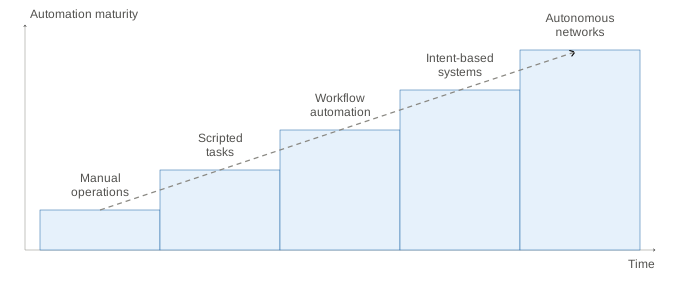
Manual Operations: Every change is a human decision executed by hand over Command Line Interface (CLI). Fast for a single engineer on a familiar device, unreliable at any scale. The network is only as consistent as the person who last touched it. There is no audit trail beyond login records.
Scripted Tasks: Repetitive work gets wrapped in scripts. A script generates configs from a spreadsheet; a loop applies the same change to fifty devices. Fragile at the edges: every variation in device state, vendor behavior, or naming convention requires a new script or a new exception. This is where most teams start, and where many stay.
Workflow Automation: Scripts are replaced by structured playbooks and pipelines. Changes are reproducible, auditable, and can be triggered through self-service interfaces. The automation still describes how to configure devices rather than what the network should look like. State reconciliation remains a manual activity. Teams at this stage often describe their automation as working well, until the environment changes.
Intent-Based Systems: The network is described as intent (what you want) rather than configuration (how to achieve it). A source of truth holds that intent as structured data. Automation engines translate intent into device state and validate the result. When the environment changes, the intent stays stable and the execution layer adapts. Most of this book is about building this layer well: the source of truth, execution, observability, orchestration, and presentation blocks in Part 2 are the components of an intent-based system.
Autonomous Networks: The system observes its own state, detects deviations from intent, and closes the loop without human intervention. This requires the intent-based layer to be reliable, well-understood, and operated with discipline. Parts 4 and 5 explore the patterns that enable this: closed-loop automation, self-healing networks, and the organizational conditions that make autonomous operation trustworthy.
Parts 1 through 3 of this book build the architectural foundation for intent-based systems. Parts 4 and 5 address what it takes to step toward autonomous operation. Most organizations today sit between Scripted Tasks and Workflow Automation. The goal is not to skip ahead: it is to build each layer on solid foundations so the next layer doesn’t require rebuilding what came before.
What actually changes at scale is not the goal but the architecture. Automation designed for 50 devices exposes its shortcuts at 500. Playbooks that embed implicit naming assumptions fail when the network grows beyond one team’s working knowledge. Part 3 examines what breaks when an automation platform moves from dozens of devices to thousands, and how to design for it from the start.
A hidden benefit of network automation is that it motivates you to simplify your network architecture as much as possible to facilitate automation. Complexity that was tolerable when managed manually becomes an active obstacle when automation must reason about every exception.
Full automation is a long-term goal. Automation doesn’t replace people: it amplifies expertise, letting engineers focus on design and problem-solving. The real wins are consistency, reliability, and speed. Automation also enables things impossible to do manually at scale: real-time validation, instant compliance checks, coordinated changes across hundreds of sites simultaneously.
Here are a few examples of what automation could look like across different environments:
Hyperscalers
- Take a design and expand it into all the data needed for network intent: racks, devices, cables, Internet Protocol (IP)s, overlay, networks. Use that to generate the Bill of Materials (BOM) and bootstrap configs served via Zero Touch Provisioning (ZTP) when devices connect.
- Correlate observability data (metrics, logs, flows) into real-time events enriched with context. Trigger workflows that mitigate user problems: draining connections while keeping capacity within SLA.
Service Providers
- Full-mesh testing of Internet links across transit providers. Keep packet loss and latency within tolerance. Detect issues, drain traffic from suspect links. Bring them back when fixed.
- Watch for circuit maintenance notifications from providers (email, webhooks). Convert to structured data. Mute alerts or proactively react to minimize impact.
Enterprises
- Self-service portal where users define security policies. Convert them to firewall rules following enforcement policy. Enable rule lifecycle that cleans up unused rules.
- Device refresh and lifecycle management. Detect End of Life (EOL) devices, flag software vulnerabilities, automate upgrades, facilitate platform migrations.
The key: identify which processes are most time-consuming, error-prone, or critical. Understand how they support your business. Then evolve them into more efficient, automated versions.
These solutions can be simple or complex, but they share common patterns. This book analyzes those patterns and ends with sophisticated real-world use cases in Part 5.
However, even with good intentions, things go wrong. Here are common pitfalls to watch for.
Common pitfalls to avoid#
You’ll discover many pitfalls throughout this book because I’ve experienced them firsthand. Here are a few to keep top of mind:
- Trying to automate everything at once: Start small. Pick high-impact, low-risk use cases to build confidence and expertise.
- Embedding intent inside tools: When naming conventions, IP allocation strategies, and vendor behavior assumptions live inside playbooks and scripts rather than in a shared reference, there is no single description of what the network should look like. When the environment changes, every embedded assumption breaks at once. Intent belongs in its own place, shared by all automation components.
- Underestimating data quality: Automation is only as good as its data. Invest in accuracy and consistency early because data is always growing and it shouldn’t increase your “data debt” (or messy data) with it.
- Building without testing: Test and validate before deploying to production. It doesn’t need to be 100% accurate (it can’t be), but covering many potential issues before targeting production increases the trustworthiness of the system.
- Automating the current network instead of designing for change: Automation built around the current topology, vendors, and naming conventions works until something changes. Before building any automation component, ask not “does this work now?” but “does this still work when the environment changes?” Encoding the present network in automation creates technical debt that compounds every time the business evolves.
- Building for the engineers who built it, not for the people who use it: An automation platform designed only for the team that built it is a single point of failure. The application team submitting a service request, the operator approving a change gate, the auditor reviewing a compliance report: each has different needs, different vocabulary, and different expectations. Keeping those users in mind from the start shapes every architectural decision: how the API is structured, how errors are surfaced, how status is communicated. Automation that engineers understand but consumers cannot use will be quietly bypassed.
Finally, let your work speak for itself. Define and track measurements that objectively show the benefits of network automation and how they impact the business.
Measuring automation success#
Focus on two groups: technical metrics and business metrics. Both matter to leadership and to your team.
Technical Metrics:
- Mean Time to Recovery (MTTR): How quickly can you detect, diagnose, and resolve network issues?
- Change Success Rate: What percentage of network changes are deployed without causing incidents?
- Configuration Drift: How consistent are device configurations across the network?
- Deployment Velocity: How quickly can you implement new services or configuration changes?
Business Metrics:
- Service Availability: Are automation-managed services more reliable than manually managed ones?
- Engineering Productivity: Are teams spending more time on strategic work versus operational tasks?
- Compliance Posture: How quickly can you validate and remediate compliance violations?
- Resource Utilization: Are you making better use of network capacity and performance?
Track these metrics regularly. They justify continued investment and show where to improve. Chapter 7 covers how the Observability block collects and surfaces these metrics; Chapter 15 connects them to business value and platform product thinking.
Summary#
The logistics company’s automation platform from the chapter’s opening was technically competent. The failure was architectural: no single description of intent, no separation between what the network should look like and how to get there, no way to reason about the system when the environment changed. That failure shape is not unusual. It is the default outcome when automation is treated as a collection of scripts rather than a platform with principled design.
The forces driving automation are structural, not optional: the scale of modern infrastructure, the expectation of developer-speed self-service, and the increasing cost of operating networks manually. Organizations that treat automation as a tooling problem discover that every new environment requires rebuilding from scratch. Organizations that treat it as an architectural problem build something that compounds.
The three pillars (People, Process, Technology) are a dependency chain, not a checklist. The technology choices that scale are the ones made in service of clear process, by people who understand the problem. Getting this order right is what separates automation that grows from automation that has to be rebuilt every few years.
The automation spectrum runs from manual operations through scripted tasks, workflow automation, intent-based systems, and autonomous networks. Most organizations today are somewhere in the middle. This book builds the architectural foundation for the intent-based layer: Parts 1 and 2 establish why and how, Part 3 examines what changes at scale, and Parts 4 and 5 explore the patterns that enable the step toward autonomous operation.
The specific architectural failure in the logistics story is not accidental. It is the default outcome when automation is built without explicit design principles. Chapter 2 names those principles and maps each one to the class of failure it prevents.
References#
- Network Programmability and Automation, 2nd Edition, Matt Oswalt, Christian Adell, Scott S. Lowe, and Jason Edelman (O’Reilly, 2023). The comprehensive practical guide to the tooling and skills this book builds an architecture around; the natural companion for readers moving from “why automate” to “how.”
- The Phoenix Project, Gene Kim, Kevin Behr, and George Spafford (IT Revolution, 2013). A narrative account of the cost of manual, unmanaged operations and the case for treating delivery as a system; the organizational forces behind the “perfect storm” in the Perfect Storm section.
- The DevOps Handbook, Gene Kim, Patrick Debois, John Willis, and Jez Humble (IT Revolution, 2016). The practical patterns for flow, feedback, and continuous learning that underpin the People, Process, Technology dependency chain in the How to approach network automation section.
- Accelerate: The Science of Lean Software and DevOps, Nicole Forsgren, Jez Humble, and Gene Kim (IT Revolution, 2018). The empirical research behind measuring delivery performance; the foundation for the automation success metrics in the Measuring automation success section.
💬 Found something to improve? Send feedback for this chapter